

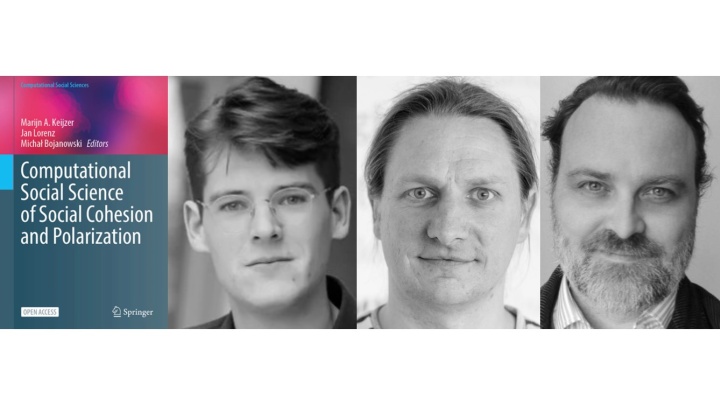
Book "Computational Social Science of Social Cohesion and Polarization" out at Springer
Today Springer published the Open Access book "Computational Social Science of Social Cohesion and Polarization", edited by Jan Lorenz, Marijn Keijzer, and our own Michał Bojanowski. The book covers a diverse range of Computational Social Science approaches to questions about social cohesion and polarization, such as agent-based models, computational text analysis, studies of social media and parliamentary speeches, network analysis, and more! You can download it from https://link.springer.com/book/10.1007/978-3-032-01373-6
Contributions come from research projects that were incubated during two Summer Schools and Research Incubators on Computational Social Science enabled by a grant from the VolkswagenStiftung (e.g., https://wedsss.janlo.de/schools-2018-2023/social-cohesion-2022-groningen/).
Among the chapters in the book is a study into the cohesion of the societal-level network created by personal networks, written by Michał Bojanowski, Alla Loseva, Paul Schuler, Susanne Böller, and Miranda Lubbers. Employing methods developed in the PATCHWORK project at the COALESCE Lab, we ask, among other things, whether groups such as migrants or unemployed people tend to occupy peripheral positions in social networks.


